
When great images hide
the ones that could’ve sold
Search results can be relevant, well-keyworded, and highly ranked, but still fail to give buyers better choice or help more of your collection get seen, considered, and ultimately licensed by the right buyers.
Sorting and prioritising. Focusing on what matters.
More looks. More chances to make sales.
The first page of search results is valuable selling space. Filling it with several strong but similar images limits the number of buying options a customer actually sees.
A more diverse result set brings forward different angles, moods, settings, styles and interpretations, giving more images a genuine chance to match the buyer’s brief.
The aim isn’t to push good images down. It’s to stop good images competing with near-identical alternatives when a broader mix could create more licensing opportunities.
Too much repetition
Similar images can dominate the first results buyers see.
Alternatives get buried
Different, potentially better-selling choices disappear further down.
Selections look small
Buyers may assume there is less variety than actually exists.
Search quality suffers
Relevant results are not necessarily useful results.
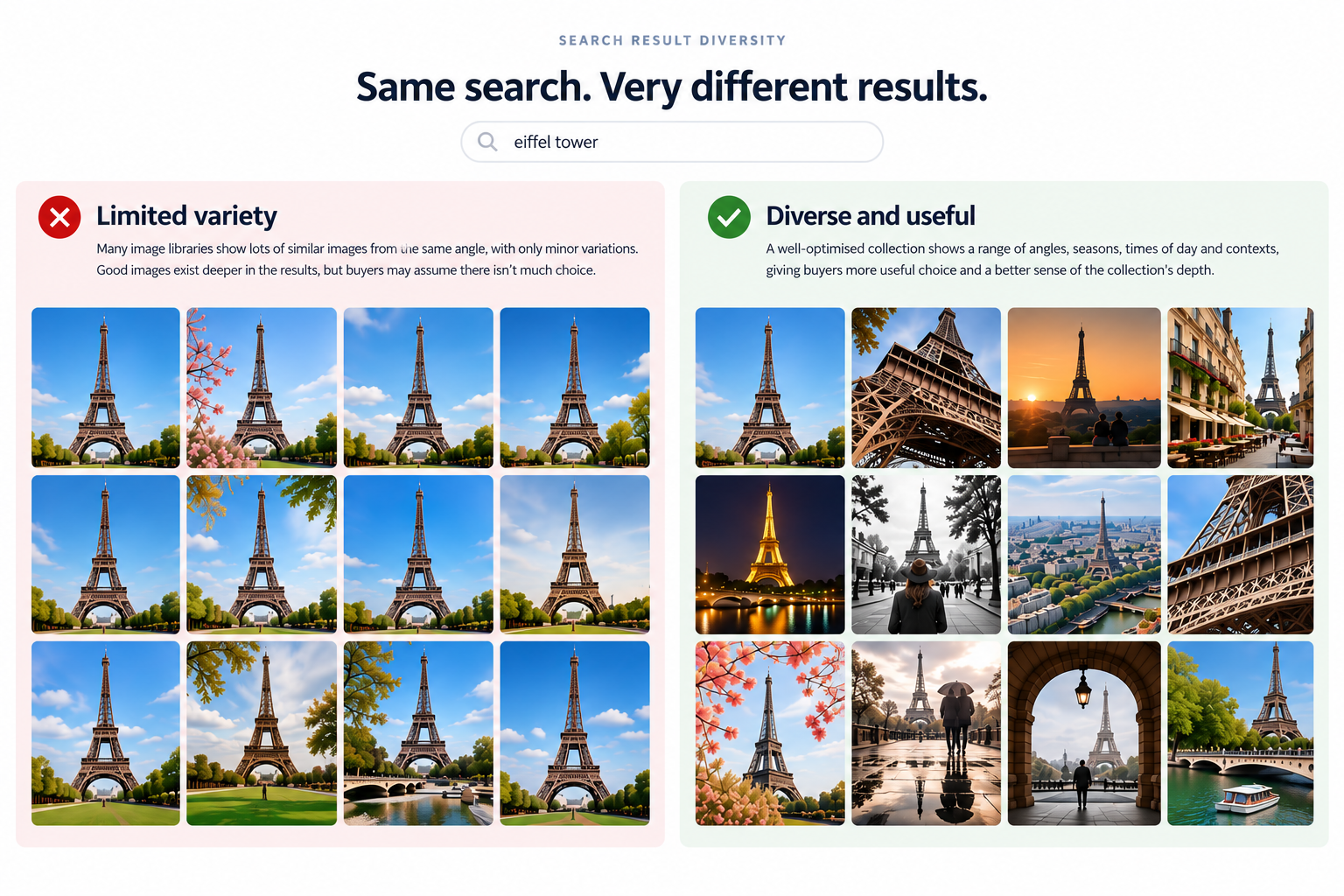
How better search diversity works
Search diversity does not mean showing weaker or less relevant images simply for the sake of variety. It means making better use of the most valuable positions in a search result by balancing relevance, quality and difference.

ONE
Find the repetition
Search diversity does not mean showing weaker or less relevant images simply for the sake of variety. It means making better use of the most valuable positions in a search result by balancing relevance, quality and difference.

TWO
Keep the strongest
The best image from a similar group should still be given prominence. The aim is not to suppress successful content. It is to avoid using several valuable early positions to show alternatives that add very little new choice.

THREE
Bring choices forward
Once unnecessary repetition is reduced, other strong and relevant images can move higher. Different viewpoints, moods, locations, treatments, contributors and interpretations give buyers more ways to find something that fits their brief.

FOUR
Centre relevance
Diversity only works when the alternatives remain genuinely useful. The goal is not random variety. It is to show the strongest range of relevant choices while keeping less useful repetition further down the results.
What better search diversity does for you
Better search diversity helps buyers see more of what your collection has to offer. By reducing unnecessary repetition and bringing forward genuinely different options, you give more strong images a chance to be seen, considered and licensed.
Give buyers more real choice
Help users reach strong, relevant content without having to work through dozens of similar alternatives.
Increase licensing opportunities
More visual variety gives more strong images a genuine chance to match the buyer’s brief, stand out and ultimately get licensed.
Reveal what buyers didn’t know they wanted
Buyers often start with only a rough idea. A broader range of strong, relevant images helps them discover options they may never think to search for.
Keep strong images working harder
The best images still lead, but they no longer crowd out other saleable alternatives that offer something different.
Get more of your collection seen
Bring forward strong images that would otherwise sit behind clusters of similar results.
Show the true depth of your collection
A broader result set makes the library feel richer and more useful, because buyers see more of what is actually there.
Finding out if this is right for you
We can review your public-facing search experience and identify whether repetition, ranking, metadata or lack of visual variety may be limiting how much of your collection gets seen. There’s nothing to upload and no obligation. We simply assess what is there and tell you what we find.
We review your collection
We look at the public-facing search experience as a buyer sees it, including the quality, variety and ordering of results.
We identify the opportunities
We look for excessive repetition, buried alternatives, weak diversity, ranking issues and anything else that may be narrowing buyer choice.
Start with a trial batch
If we identify a worthwhile opportunity, we can apply the approach to a defined batch of images so you can see the effect before deciding whether to roll it out more widely.
Can we help buyers find your images?
We’ll review your website search results, looking at metadata and library structure to see whether strong content may be getting missed, buried or overlooked. You decide if improvement is needed based on our report.
FAQs: Search diversity
What is search diversity?
Search diversity is about giving buyers a broader range of strong, relevant choices instead of allowing very similar images, shoots or viewpoints to dominate the first results.
Does search diversity mean pushing strong images down?
No. The strongest images should still lead. The aim is to stop several similar strong images occupying valuable early positions when other relevant alternatives could give the buyer more useful choice.
How is search diversity different from image ranking?
Ranking assesses how strong an individual image is. Search diversity looks at the result set as a whole and asks whether each image adds something genuinely different to what the buyer has already seen.
Why does search diversity matter commercially?
A broader mix of strong results gives more of your collection a chance to be seen and licensed. It also helps buyers discover images, treatments and ideas they may not have thought to search for directly.
Can you assess our current search results?
Yes. We can review your public-facing collection as a buyer sees it and look for repetition, buried alternatives, limited visual variety and other issues that may be restricting choice. There is nothing to upload for the initial assessment.
Can we test search diversity before applying it widely?
Yes. If the assessment identifies a worthwhile opportunity, we can start with a defined trial batch so you can compare the results before deciding whether to extend the approach across more of the collection.