
Help buyers find your best images
Give your strongest images the best chance to be found, chosen and licensed.
Having so many images and videos stops your best being seen and sold. We find your strongest assets and help buyers see them too. That means sorting collections, choosing hero shots, adding/improving keywords and clearing clutter from search results.
When everything’s searchable, the best disappears
Image and video libraries have grown faster than buyers’ ability to assess them. One search can now return thousands of images/videos, including near-duplicates, weaker frames and older material that competes with the strongest work. The result is predictable: buyers work harder, strong assets get buried and collections become more difficult to sell from.
Too many similar images hide the best
Buyers shouldn’t have to work through dozens of near-identical frames to find the strongest one. When every variation is given equal weight, the best image is buried by the rest of the pics in the shoot.
Your top assets may not appear first
An image or video can be relevant, accurately keyworded and still sit too far down the results to be noticed. Strong assets need to be identified and brought forward, rather than left to compete equally with weaker material.
Keywords are only
part of the answer
Good keywording helps buyers find relevant images and videos. It cannot decide which should lead, which alternatives offer useful choice, or which ones are simply making the search harder than it should be.
Aggregators don’t
put your best first
How Getty and other aggregators rank images and videos doesn’t mean your strongest assets get found. Using “Newest”, “Best Match” and “Most Popular” doesn’t guarantee buyers will see your most saleable examples.
Cut the clutter with
image/video merchandising
Successful retailers don’t put every item in the warehouse on the shop floor. They select what to display, what to feature and what should stay in the background. Without those decisions, even good products become harder to notice and harder to buy.
Image and video collections need the same commercial thinking. When thousands of assets are presented on equal terms, strong work gets lost among near-duplicates, weaker alternatives and older material that no longer deserves the same prominence.
Image/video merchandising brings order and judgement to the collection. It helps buyers reach the strongest and most useful pictures faster, while making the archive feel clearer, more relevant and easier to buy from.
Keywording remains important, but it is only one part of the process. The bigger task is deciding what deserves attention, what offers useful choice and what is simply creating more clutter.
Buyer focus
Image/video merchandising starts with the buyer, not the archive. The aim is to make choice easier by presenting stronger, more useful and more distinctive assets first, rather than expecting buyers to work through everything available.
Commercial judgement
Not every technically sound image or video has the same sales potential. We consider relevance, distinctiveness, likely demand and how well an image adds to the wider collection, so attention is directed where it has the best chance of producing value.
Human oversight
AI can process large volumes quickly, identify patterns and support metadata work. Human judgement is still needed to maximise accuracy, avoid AI hallucinations, and assess quality, context and commercial importance.
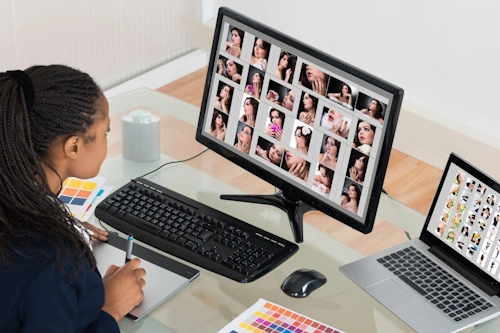
Collection Sorting
We identify which parts of a collection deserve focus, promotion and investment, and which are better deprioritised.

Ranking and Heroes
We find the hero images/videos and decide which of those deserve greater visibility, stronger metadata and more attention.

Search Diversity
Search diversity reduces repetition, broadens visual choice and helps more strong images surface earlier for buyers.

AI-Human Keywording
We combine AI speed with human judgement to add and improve keywords, descriptions and search results.
Who does merchandising help the most?
Maximising the saleability of images and videos is most valuable for those with large or growing visual collections where strong assets are being buried by volume, repetition or inconsistent metadata. It also suits teams that need buyers to find better images/videos faster, make existing content work harder and focus limited budgets where they’ll deliver the greatest return.
Image libraries and photo agencies
For collections where strong images are being buried by volume, repetition or weak search presentation.
Archives, museums, heritage bodies
For valuable collections that need clearer prioritisation, stronger metadata and better digital discovery.
Publishers and large media organisations
For teams that need consistent, searchable image content and faster access to the most useful material.
Specialist collections and rights holders
For organisations with distinctive visual assets that need more structure, visibility and commercial focus.
Trusted by industry leaders
Since 2006, Picsell has supported leading agencies, archives, publishers and international organisations with metadata and collection work.


What merchandising delivers
Image merchandising isn’t just about organising a collection. It helps buyers find better images and videos faster and helps you get more from the content you already own.
More value from existing images
Strong imagery already in the collection have a better chance of being seen, used and licensed.
Faster buyer decisions
Buyers reach the most relevant images/videos without working through repetitive or weaker results.
Smarter use of budgets
Time and metadata investment can be focused on images/videos with greater commercial or collection value.
A clearer buying experience
The collection becomes easier to search, understand and buy from.
Can we help buyers find your images?
We’ll review your website search results, looking at metadata and library structure to see whether strong content may be getting missed, buried or overlooked. You decide if improvement is needed based on our report.
FAQs: Picsell Media merchandising services
What is image merchandising?
Image merchandising applies the same commercial thinking used by successful retailers to visual collections: deciding what should lead, what provides useful choice and what deserves less attention. For image libraries, that means sorting collections, identifying stronger assets and ranking images and videos so buyers can reach the best material faster.
How is image ranking different from keywording?
Keywording determines whether an image is relevant to a search. Image and video ranking determines which relevant assets are strongest, most distinctive or most useful. An image can have excellent keywords and metadata and still remain buried among repetitive or weaker alternatives.
Do you use AI or human specialists?
Both. AI helps us process large collections efficiently, identify patterns and support metadata creation. Experienced people review the results and make the final decisions about accuracy, context, quality and commercial importance. Our AI-human keywording service combines both approaches.
Can you work with our existing metadata?
Yes. We can review, improve and standardise existing keywords, captions and other metadata rather than starting again unnecessarily. Our AI-human metadata services can be adapted to the quality of your existing metadata, your vocabulary and what you need the collection to achieve.
Do you work with older collections as well as new images?
Yes. We work with newly produced material, existing commercial libraries and older archive collections. Older collections can benefit particularly from collection sorting, stronger prioritisation and updated metadata because valuable assets often become difficult to find over time.
Do you have to process the entire collection?
No. A project can start with a particular collection, subject area, search problem or commercially important group of assets. This allows effort and budget to be concentrated where improvement is likely to deliver the greatest value. Contact us to discuss an appropriate starting point.
Who benefits most from these services?
Picsell’s services are most useful for organisations managing large or growing visual collections where good images or videos are being buried by volume, repetition or inconsistent metadata. This includes image libraries, photo agencies, archives, museums, publishers and specialist rights holders.
How are projects priced?
Pricing depends on the size and condition of the collection, the services required and the level of human review involved. Once we understand the collection and the problem you want to solve, we can recommend an appropriate scope and provide a clear estimate. Get in touch to discuss your collection.