
AI-human keywording
AI speed. Human judgement.
We combine AI efficiency with experienced human review to produce accurate, relevant keywords and captions at scale. AI handles the volume. Our specialists correct errors, add missing context and make sure the metadata is useful to buyers.
AI Keywording with Human Review and Flexible Service Levels
Why AI alone isn’t enough
AI is good at producing first-pass metadata quickly. It can identify objects, broad subjects, settings and other straightforward details across large volumes of images. But useful metadata needs more than recognition. It needs context, relevance, accuracy and an understanding of how people actually search.
That’s where human review matters.
Context
People, places, events and relationships are not always obvious from the pixels alone. Human reviewers can add the knowledge AI misses.
Relevance
Not every visible detail deserves a keyword. We remove noise and concentrate on terms that are genuinely useful to searchers.
Accuracy
AI can hallucinate, misidentify or overstate what it sees. Human review catches errors before they become part of your archive.
Consistency
Good metadata needs to follow the same rules across a collection. Human review helps keep terminology, style and keywording decisions consistent.
Where AI still gets it wrong
There are a series of well-known problems with AI keywording. Even AI companies themselves admit it.
“AI keywording is usually a mix of object detection accuracy, dataset biases, confidence thresholds, and context-blindness. That’s why human curation or post-editing is often still needed when accuracy matters (e.g., stock photography, search indexing).” – ChatGPT
“Human input and prompt engineering still remain a crucial component in steering AI-generated outputs toward meaningful, accurate, and impactful outcomes.” – Google Gemini
How AI-human keywording works
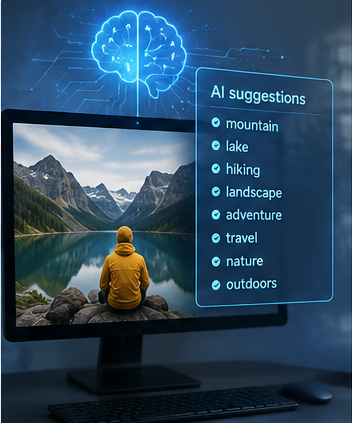
ONE
AI creates the first pass
AI generates initial keywords, captions and metadata quickly across large volumes of images or video.
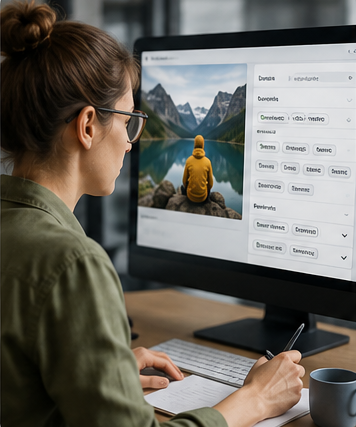
TWO
Human review & correction
Our specialists check accuracy, remove irrelevant terms, add missing context and correct anything AI has misunderstood.

THREE
Client standards applied
We apply your terminology, spelling, formatting and field requirements consistently across the collection.

FOUR
Final QA & delivery
The completed metadata is thoroughly checked and delivered in your required format, ready to use.
What better keywording and metadata does for you
The aim is to make images easier to find, understand and use while keeping metadata accurate, relevant and consistent. That means less search clutter, fewer costly mistakes and more value from the collection you already have. It can benefit image libraries, agencies, archives, museums and publishers managing large or complex visual collections.
More value from the collection
Better metadata means stronger images are easier to find, easier to understand and more likely to be used or licensed. That helps add more license fees, straight to the bottom line.
The right level of attention
Not every image needs the same depth of work. We can apply lighter review to straightforward material and more detailed attention where context, research or commercial importance justifies it.
Better context
AI keywords can only carry so much. Our team can add captions, names, places, events and relationships that give an image meaning and make it more useful in search.
Cleaner metadata
AI often adds terms that are technically visible but not useful. We remove irrelevant, repetitive or misleading keywords so the metadata works better for real users.
Fewer costly mistakes
Wrong names, locations, events or contextual claims can create reputational or legal problems. Human review catches errors before they become part of the archive.
Lower legal risk
Incorrect names, locations, events, ethnicity, age, identity or other contextual claims can create legal or reputational problems. Human review helps catch unsupported or sensitive metadata before it is published or distributed.
Choose the level of human input you want
- Reviewed – AI-generated metadata checked and corrected by a human and basic keywords added.
- Enriched – Human review plus further added context, missing concepts and more detailed keywords.
- Advanced – Deeper research, specialist terminology, with intensive checking and keywording.
- Pricing depends on the level of input you want
Finding out if this is right for you
Every collection is different, so the best starting point is to understand what you have, how your metadata is currently produced and where the problems lie. From there, we can agree the right level of human input and a sensible way to begin.
Prepared to your standards
We can work to your existing metadata specification, controlled vocabulary, spelling conventions, field structure and formatting rules. Where you have particular requirements for clients, platforms or collections, these can be built into the agreed workflow.
Clear pricing before beginning
Pricing depends on image volume, the level of human input and the complexity of the metadata required. Once the scope is agreed, we give you a clear cost for the work so you know what to expect before the project gets under way.
Start with a trial batch
You don’t have to commit an entire archive from day one. We can begin with an agreed batch of images, fields and review level, giving you a clear measure of quality, cost and turnaround before deciding how far to extend the work.
Can we help buyers find your images?
We’ll review your website search results, looking at metadata and library structure to see whether strong content may be getting missed, buried or overlooked. You decide if improvement is needed based on our report.
FAQs: AI-human keywording
What does the human review actually involve?
Our specialists check AI-generated metadata for accuracy, relevance and consistency. Depending on the level of service, they can also remove weak or unnecessary terms, add missing context, improve captions and carry out additional research.
What is the difference between Reviewed, Enriched and Advanced?
The difference is the depth of human input. Reviewed focuses on checking and correcting AI output, Enriched adds more context and useful detail, while Advanced is designed for images needing deeper research, specialist terminology or more intensive checking.
Can you improve metadata we already have?
Yes. We can work with existing keywords, captions and other metadata rather than starting again. This can include correcting errors, removing clutter, filling gaps and bringing older metadata up to a more consistent standard.
Can you work to our own taxonomy and metadata rules?
Yes. We can follow your controlled vocabulary, spelling conventions, field structure, formatting and other requirements. Where you need metadata prepared for a particular client or platform, the relevant specification can be agreed as part of the project.
Do you produce captions as well as keywords?
Yes. Captions can provide context that individual keywords cannot, particularly for editorial, archive and historically important material. The level of caption writing and any research required can be matched to the needs of the collection.
How is AI-Human Keywording priced?
Pricing depends on image volume, the level of human input, the complexity of the material and the metadata required. We normally start by agreeing a clearly defined batch so you can assess quality, cost and turnaround before extending the work further.