
Sorting and prioritising.
Focusing on what matters.
Not all parts of collections deserve equal attention. We assess them at a broad level to identify which subjects, shoots and groups of content offer the greatest value – which should be dealt with first and promoted most, and which should be ignored. That helps you concentrate time and budget where the most difference, and sales, can be made.
Collection Sorting and Prioritisation
Not everything deserves the same effort
Large collections often grow without a clear sense of where their strongest commercial opportunities lie. Subjects, shoots and whole areas of content can receive the same treatment even though their likely value is very different.
Sorting and prioritisation helps you decide where to concentrate effort before spending time and money further down the line.
Too much content,
too little focus
When everything is treated as equally important, genuinely valuable areas of the collection can be lost among material with much less potential.
Budgets get
spread too thinly
Keywording, ranking, promotion and other work costs money. Applying them indiscriminately means spending on content that may never justify it.
Older material can
hide opportunity
Valuable subjects and shoots may already exist in the archive but receive little attention because nobody has assessed them properly.
Some content is
better left alone
Not every part of a collection needs improving or promoting. Identifying what not to work on can be just as valuable as deciding what to prioritise.
How sorting & prioritising work

ONE
Map the collection
We establish what the collection contains and break it into useful groups, such as subjects, shoots, themes, dates or other categories relevant to the business.

TWO
Assess the opportunities
We look at each area in terms of factors such as likely demand, existing strengths, duplication and how well it fits your commercial or collection priorities.
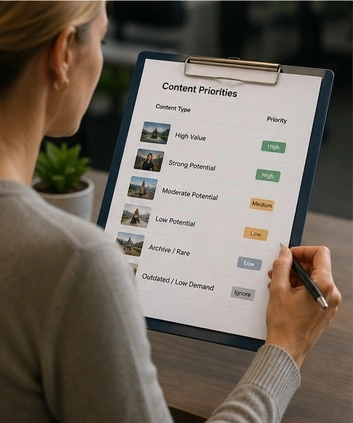
THREE
Set the priorities
We identify which parts deserve immediate attention, which should follow later and which are unlikely to justify further investment.
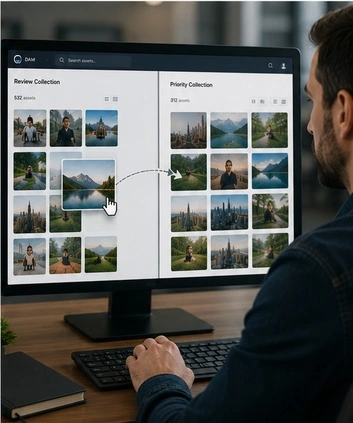
FOUR
Sort within the library
As well as working out the priorities, our team will do the work of moving images/videos into their new categories and locations.
What better sorting and prioritising does for you
Sorting gives you a clearer view of where the value lies across a collection. It helps you decide what deserves investment, what should be promoted, what can wait and what is unlikely to justify further effort.
Make promotion more targeted
Give marketing and sales teams a clearer idea of which parts of the collection are worth featuring, revisiting or putting in front of buyers.
Focus effort where it matters
Direct ranking, keywording, promotion and other resources towards the parts of the collection with the strongest potential rather than treating everything equally.
Get more from your existing collection
Concentrating effort on the right areas can help existing content work harder before you spend money creating, acquiring or processing more.
Spend budgets more selectively
Avoid investing time and money in subjects or groups of content that are unlikely to produce enough value to justify the work.
Find overlooked opportunities
Identify strong subjects, shoots or areas of the collection that may already have commercial potential but have received too little attention.
Know what to leave alone
Some content simply does not warrant more work. Recognising that early can be just as valuable as identifying what should be prioritised.
Finding out if this is right for you
The starting point is to understand how your collection is structured, where you already see commercial potential and where volume or uncertainty is making decisions difficult. From there, we can agree what should be assessed and what a useful prioritisation exercise should deliver.
Agree what matters most
We establish the factors that should influence priority, such as sales history, subject demand, uniqueness, strategic importance, collection gaps or the cost of further work. The criteria can be tailored to the way your collection makes money.
Clear scope and pricing
Once the scope is agreed, we set out the cost before work begins. The outcome is a practical set of priorities showing where to focus, what can wait and where further investment is unlikely to be worthwhile.
Start with part of the collection
You don’t need to assess everything at once. We can begin with a particular subject area, contributor, archive or section of the collection where clearer priorities would have the greatest immediate value.
Can we help buyers find your images?
We’ll review your website search results, looking at metadata and library structure to see whether strong content may be getting missed, buried or overlooked. You decide if improvement is needed based on our report.
FAQs: Sorting and prioritising
What is the difference between sorting and image ranking?
Sorting and prioritisation works at the collection level. It identifies which subjects, shoots or groups of content deserve attention first. Image & Video Ranking works at the individual asset level, deciding which images or clips should lead within those priority areas.
How do you decide what should be prioritised?
The criteria are agreed with you before work begins. They can include sales history, subject demand, commercial potential, distinctiveness, strategic importance, duplication, existing collection strengths and the likely cost of further work.
Can you use our existing sales and usage data?
Yes. Where useful data is available, it can help show which parts of the collection already perform well, where demand exists and where further investment may have the greatest potential.
Does a low priority mean content should be deleted?
No. A low priority simply means that the material is unlikely to justify significant attention or investment at the moment. It can remain available in the collection without being actively worked on or promoted.
Do you need to assess the whole collection?
No. We can start with a defined part of the collection, such as a subject area, contributor, archive, date range or other meaningful group, and expand the work if it proves useful.
What happens after the collection has been prioritised?
You receive a clearer set of priorities showing where to focus effort and where less attention is justified. Those decisions can then guide ranking, metadata improvement, promotion and other collection work.
How is sorting and prioritisation priced?
Pricing depends on the size and structure of the collection, the amount of data available and the depth of assessment required. Once the scope is agreed, we provide a clear cost before work begins.